vrijdag 19 oktober 2012

Paradise Revisited

After quite some considering about what way to choose to extend my visa it all ended up being quite spontaneous anyway: Karlien (my classmate) was going to be in Bali with her parents and asked if I didn’t want to visit them. Thinking that maybe some distance and a break would be good for my fieldwork I booked a last minute ticket and so on Monday afternoon I was boarding the plane to Bali. Boarding the plane inevitably gave me a preview of how it will be to do the same in December and somehow I was very happy I was not leaving for good yet! To meet Karlien like this, on the other side of the world, had something very strange and very normal at the same time…It was really nice to be able to catch up and share experiences, worries and joys with somebody who is going through roughly the same although Singapore and Timor Leste share little more than the same side of the world I would say…I was very hospitably taken into the family and taken everywhere with them, which gave me the chance to see some things of Bali I would not have gone to on my own. The highlight was something that according to Karlien we could actually not miss as anthropologists and that was a Balinese Cockfight! (One of the most famous Anthropological texts ever written is about the Balinese Cockfight, written by Geertz) Now, as a vegetarian I found it actually a bit hard to excuse myself to go such a thing, but in the end I thought that this was a once in a life-time experience and that watching a cockfight fought between roosters that have been pampered all their lives is probably better than eating a bio-industry chicken and so I gathered enough arguments to get myself to go. Actually I surprised myself with not finding it that hard to watch at all… The scale of it (a reasonable arena), the fact that they do it every (!) day and the intensity of the betting took me by surprise! It was absolutely fascinating to watch how men, with hand movements that most of the time escaped my comprehension, agreed on sums of money and on the rooster they were betting on. After a fight, while the loosing rooster was already being prepared for dinner so to say, money would be given, passed or thrown through the arena to settle the bets… Here you see men who are offering their bet for the preferred rooster, trying to find someone who is brave enough to bet on the rooster who is thought to be the weakest
What also fascinated me was the relationship between the men and their roosters. Roosters are pampered, put in and out of the sun, fed special food, massaged and spoiled around half a year until they start their fights, but then it can be suddenly over in one fight, and if the rooster loses, the owner seems to have lost any affection for the animal, drops it to the floor and somebody else will take it to be slaughtered. Somehow I found this a cruel and fascinating loss of affection. If you look well on this picture you can see the size of the knife the roosters get tied to their paws (it is huge!) and also you can see that probably the owner is more nervous than the rooster (even though this rooster won its fight after this picture was taken)
And the rooster of the previous picture deals a fatal blow to its white opponent
And here are the two anthropologists stepping in the footsteps of Geertz who was actually directly or indirectly responsible for us being here!
After the cockfight our journey took us past endless rice fields and the green everywhere astonished me after the brown of dry-season Timor Leste
What also fascinated me about Bali was that people, everywhere, all the time, seemed to be engaged in some religious ceremony! I have never seen anything like that…It was Tuesday morning but everywhere we passed ceremonies taking place, people walking in a procession, people celebrating various marriages or people bringing little offerings in their domestic temples. That devotion towards the spirits, towards Mother Earth and all the other things I have no understanding of had something special. I was particularly amazed by the roof-architecture of the temples
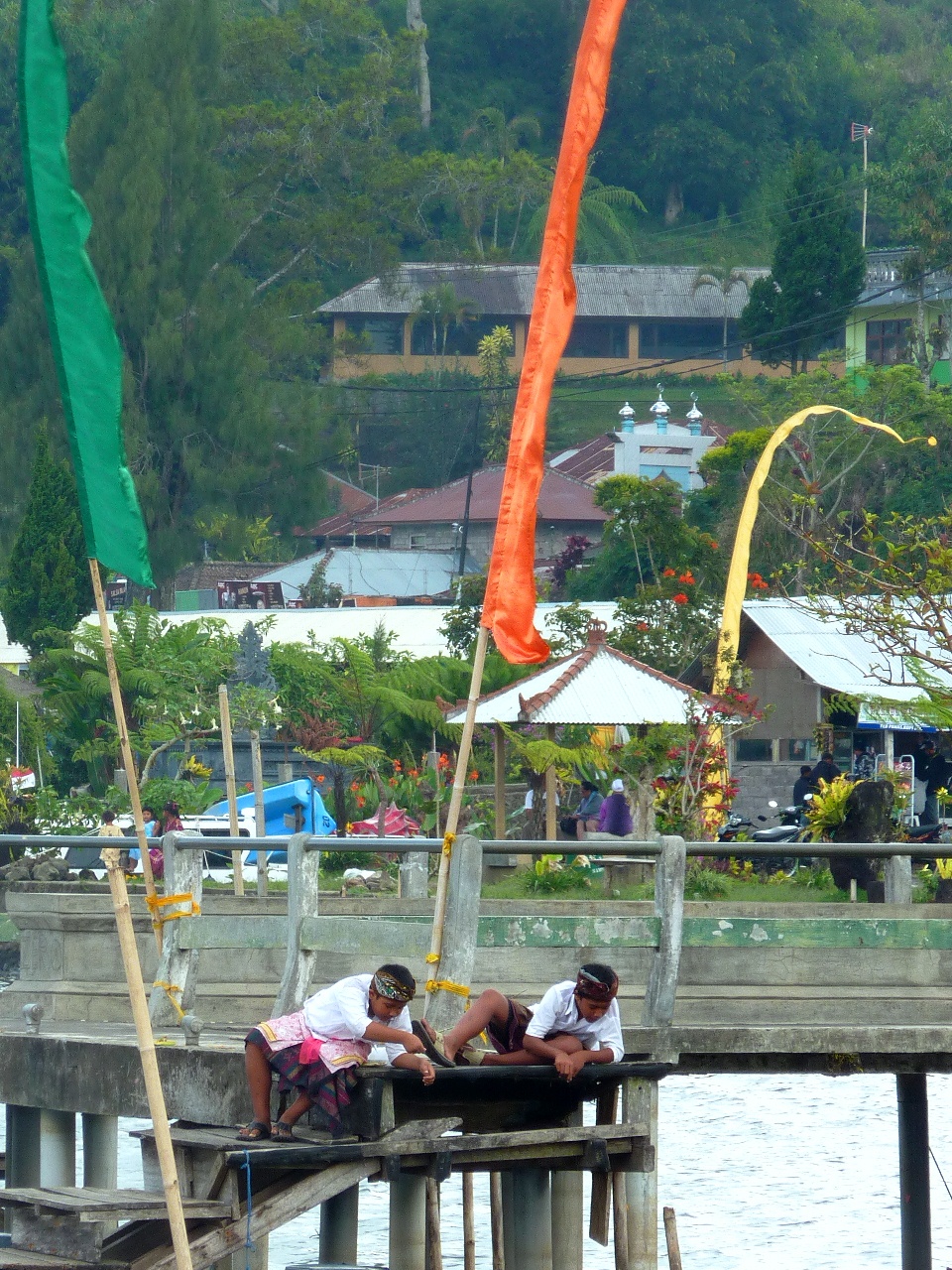
And here are two boys taking a break from a ceremony to fish in the lake at 1.700 meters altitude
Bali is famous for its resemblance to paradise, at least that is what people say. And I have to say that if you chill by the swimming pool of your hotel, while the flowers drop from the trees, the sun shines in a blue sky and various Buddha’s and Shiva’s and Vishnu’s gaze serenely over you, it comes quite close
But that is not the whole story…after spending two and a half months in Timor Leste I was shocked not only by the wealth but also the opulence. I was repulsed by how fat most of the tourists were, how loud they spoke. I was scared away by the eternal smile on the faces of people offering you all the things that you can imagine to buy with money while they are rudely rejected by tourists who want to enjoy paradise…after visiting parts of Timor Leste in the back or a truck, in the middle of Timorese with guitars and laughter I felt isolated in that car, with air-conditioning, and a friendly tour guide who takes you from one rice-field-view to the other rice-field-view…I felt like I was locked up in a bubble I could not see clearly through, I was looking for the paradise everybody talks about but I couldn’t find it, it was not my paradise…and when I got ill on the last day all I wanted was to go back to my own paradise. A paradise that is not perfect, a paradise that combines beautiful views with garbage in the streets, a place that combines people’s friendliness with stories of the dark side of humanity, a place that both feels like home and like very far away from home. But at least nobody there ever promised me anymore than there really is. Nobody told me it would be paradise there, and still I found it in some places…

zondag 30 september 2012

Singing, coffee and happiness

Dear all, I have so much that I could write that I feel I have to choose…And because I am sunburned and tired but very happy and thankful too after a weekend away with Ba Futuru (the NGO where I do volunteer work), I choose to write something about this part of my current life in Dili, Timor Leste. Every Monday and Wednesday, at 13.30 I walk 2 minutes to the big road, cross it and stand in front of the Headquarters of the Timorese Military forces until a microlet stops which means that somewhere in there, according to the driver, is a little space where you can squeeze in, even though sometimes at first it really does not look like that to the outsider…after driving for about 20 minutes surrounded by a number of decibel that cannot be healthy for you on the long run, I get out and walk into Ba Futuru and am greeted by a number of voices saying “Mana Sara, Boatardi, Diak ka lae?” At 14.00 we start with drama class: first warming up (and that while it is already quite hot enough I would say). After that we sit together and discuss the themes that the participants picked for their Peace Promotion Tour (November). We split up in two groups and each takes a theme for that week (for example Domestic Violence and Unemployment) and has a brainstorm about what kind of story they could make for that (often, although not always, based on their own experiences). Here it is important that the theater piece presents [1] a problem, [2] a solution that informs the public about their rights/possibilities/duties and [3] a message related to that possible solution. And then, based on the plot we thought out, participants start improvising and staff provides ideas and feedback, or reminds them not to turn their back to ‘the public’ and in this way, slowly, a short theater play unfolds itself. It continues developing when we join the two groups and act for each other and give each other feedback. Time almost always flies and before we know it, it is already 17.15 and time to get into a microlet, together with some of the participants who have to go the same way, so that around 17.45 I walk into my street, while the sunlight turns into late afternoon gold and people all over the place make their way home. This is what we normally do…but because the good things in life are (mostly) the things that happen outside daily routine I want to focus on two activities I did with the people of Ba Futuru in the last month. The first was a Sunday in the beginning of September, there was a kids’ bike tour from the city to the Cristo Rei beach and Ba Futuru, together with other organizations, was there to entertain the kids once they got there. We had two guitars and body paint and this did not only serve to entertain the kids but also ourselves. It was a morning full of laughter, singing, painting and jokes. The children were not the only ones eager to get their arms ‘tattooed’ or their face painted, here is one of the staff receiving a new face while onlookers watch the process fascinated.
Two children waiting on their turn
One of the participants, very skilled in ‘tribal’ tattoos :)
I did not get one, my skin is already interesting enough here…
When I got home I was wondering how it is possible that you can have such a wonderful time with people who you barely know and whose language you barely speak. This weekend there was a kind of camp for the participants in Ermera, the coffee district of Timor Leste, to the west of Dili. I had not gone west of Dili yet so I was very excited to get the chance to come along. We left Friday morning. In Timor Leste, when around 30 people go on a trip you hire a lorry, you pack all the bags in it and then you pile the people on top of them. Add two guitars, a djembe, a lot of songs and very high spirits and you get Ba Futuru! The sun burns, the road is bumpy and the dust swirls around you but that barely matters. I found out I preferred standing over sitting because then you actually also get to see something and your legs get some movement. This picture is nevertheless taken from a seated position somewhere halfway the truck.
After four hours of traveling and one leaky tire we got off somewhere quite in the middle of nowhere and continued afoot for about an hour more. One of the characteristics for Ba Futuru, for me, is that the guitar playing and singing never stop, not even while hiking. It is impressive how everyone here seems to know how to play guitar and how the list of songs, either Tetun, or Brazilian, or classics like ‘No Woman No Cry’ translated to Tetun, is never ending.
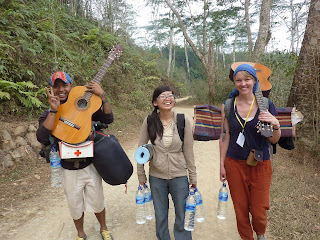
The special thing, no, actually one of the special things, of this weekend was that the activities took place in the hometown of one of the staff members who invited two of his cousins to come along. All three know the area very well. This allowed us to walk little forest paths where barely anybody else goes and end up one a very peaceful place on this earth, were a car is an extremely rare visitor, where there is no electricity, where the water comes from a little brook, where you are received by a sweat old couple of grandparents and their chickens and dogs, where you can make use of their ‘bathroom’, and where you get fresh vegetables out of their garden, where at night (once everyone is finally asleep) you only hear birds and crickets and where you get to see sunsets like this
It was truly one of the most beautiful campsites I have ever seen and I repeatedly, at different points of the day, just stood at the spot where the previous picture was taken, gazing about me, wondering what the hell I did in a previous life to deserve a view like this  If you look well you might see that there is a river which flows in direction of the sea. A few minutes after this picture, the water of the river lighted up with the sun. It was amazing…too amazing to catch in something like a picture… We had two to three people per tent. The participants were divided in four groups and each organized their own food so the campsite was full of cracking campfires, cooking pots and people walking from one fire to the other to borrow a spoon, to talk to a friend, or to join in with a song. At night it was really quite chilly, something impossible to imagine here in Dili. Even though I had managed to convince myself to take my fleece, which seemed ridiculous, I was still cold at night. Saturday we hiked through the coffee fields. I had imagined coffee fields to be something very organized but it was not. Although at some spots coffee plants have been planted in rows, like the picture below, in most places coffee plants just grow in the wild and people pass by them to harvest coffee. At the end of the season they cut the plants short to be able to reach the coffee next year, because the plants can get quite high. The coffee picking season was now over so all the plants were reduced to trunks with some leaves. I fell in love though with the trees that provide the shade for the coffee…there are so majestically tall! So beautiful with their white bark and flat top!
This part of Timor Leste was the first to be colonized by the Portuguese who had coffee farms here. It has something astonishingly familiar and at the same time bewilderingly unrealistic to walk into such a typical 1940’s style Portuguese house in the middle of the Timorese forest!
What also took me by surprise was that the participants were very excited to get to see the statue of the greatest Portuguese ‘pacificator’ and first governor in Timor Leste…Personally I could not get myself to be very enthusiastic about that man with his moustache who was apparently very successful in taking other people’s land, but I guess for the participants it is part of their history… And no-one can say that they are not proud of being Timorese, if they walk around the whole day like this:
The walk was hot, offered stunning views, and was quite a challenge for some among us walking on flip-flops. But we managed! At the end we were to do some animation at the local school. Sadly a huge deluge broke lose so we were confined to the tiny dark classroom with barely any tables and where soon the water was flowing past our ankles. But I think the children enjoyed the drawing and there was, of course…music!
When we got to the campsite e-ve-ry-thing was wet. Some people stated that you could fish in their tents…I was amazed by the fact that nobody got grumpy (which prevented me from doing so, even though I had been planning to). It was cold, wet, there were barely any dry clothes to be had and there was the perspective of a cold and wet night but nevertheless people sang, laughed and joked and squatted around their little smoking fires with their cooking pots. Later we made a big fire which enabled us to dry our (plastic) sleeping mats, and some clothes, and to get a bit warm. The campfire was the best place to be and so I stayed there, together with some others, as long as possible, until the perspective that three hours would be doable compelled me to try to get some sleep. I just want to share with you that we had guitars, but to build a drum set on location is also no problem at all, in case you might think so:
It was a very beautiful weekend and I think that has to do with various things. Firstly, I am proud to announce that it was very close to a Tetun-only weekend during which I used English only as a last resort. Secondly, I think that the almost constant presence of live music, of people who sing and play together because they enjoy doing so creates a special atmosphere to which I am susceptible. Thirdly, it was just really nice to get to know a little bit more of Timor Leste’s countryside. And last, but definitely not the least, the feeling of being accepted into this group of people to whom some weeks ago I was a stranger: to give and receive hugs, to walk together, to be hot and sweaty and cold and wet together, to eat together, to sing together and to laugh together, we sang and we laughed a lot… Sara

zaterdag 8 september 2012

Sara, from Fatuhada

Dear all A bit more than a week ago, the little boys who always play soccer in my street asked me what my name was. Since then when I pass by they often yell “Bondia Sara!” or “Mister Sara, where are you go?” (somehow all malae are ‘mister’ here, even if you are a woman). Some days ago I was at university working in the Peace Center and a student came in asking for one of my colleagues. I went up to him to tell him she was not at uni that day. He looked at me and then stated: “You are Sara, from Fatuhada!” (Fatuhada is the neighborhood where I live). Now it happened to me already more than I would like to admit that I don’t remember people who I apparently had already met, so I asked this young man whether we had already met before and he said: “no, but I live in your street, so I know you are Sara from Fatuhada”. I had to laugh. I am Sara from Fatuhada now! I felt like somehow I had been accepted into a community of whose existence I was not really aware. But I guess that is slowly the trend of the last weeks: my presence starts to become normal in places, people recognize me and little by little people start treating me more like Sara and less like a malae. My only frustration is that my Tetun is advancing slower than I had hoped (mainly because I am not forced to speak it as almost everybody speaks either English or Portuguese). Although I understand everyday a little more I think I will take some serious classes to speed up the process… A routine is slowly starting to form itself in my weeks, and consequently time is starting to fly. I spend a few days at uni, and a few afternoons at Ba Futuru. I also spend many hours like this:
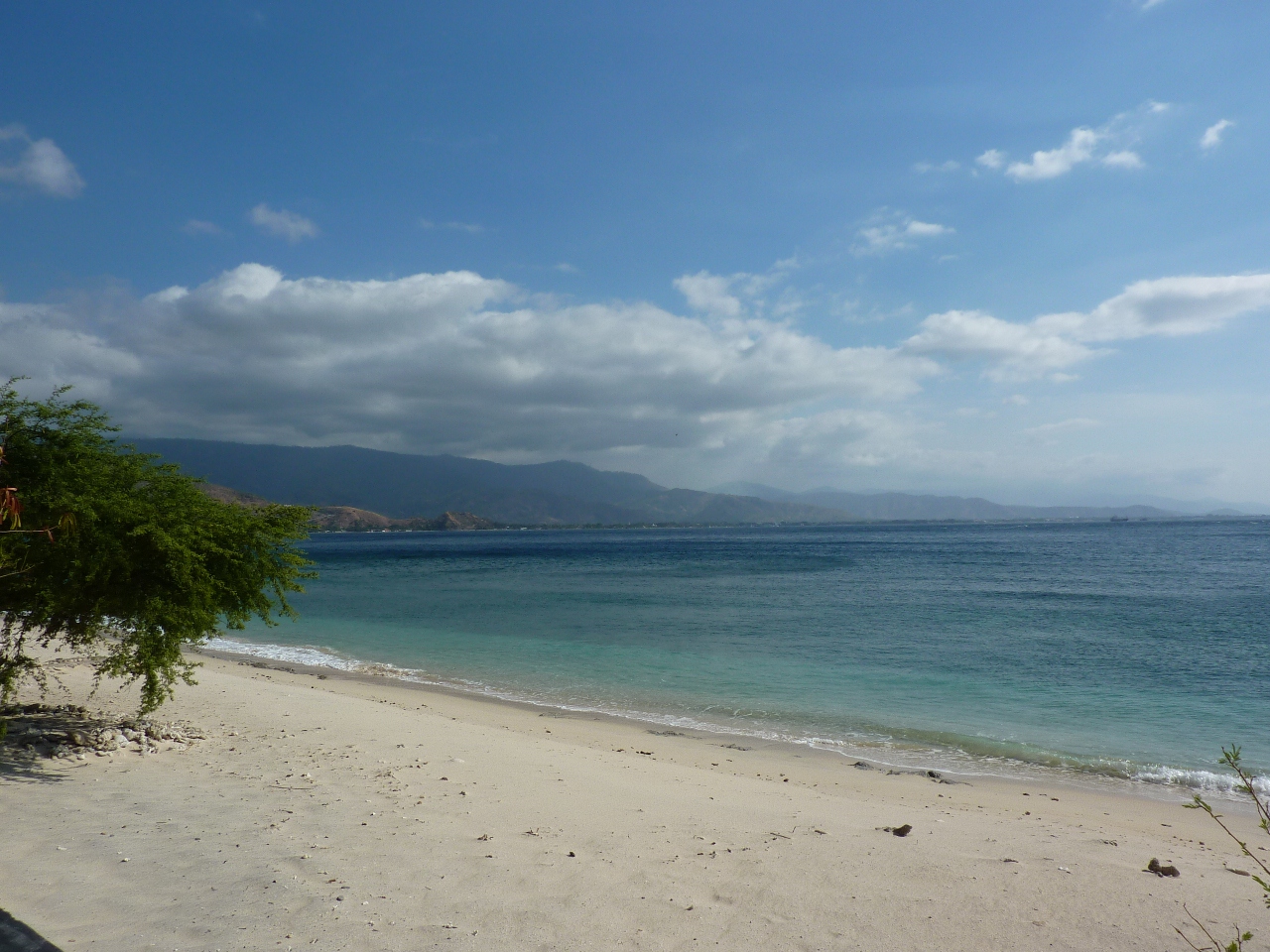
Typing out field notes, writing writing writing, thinking, learning Tetun or reading articles. I mostly get up around 7.00 and that is actually the most beautiful time of the day, just after the sun came up, when the air is still fresh, the mist still hangs at the bottom of the hills, and the city is slowly woken up by an orchestra of crowing cocks.
One and a half weeks ago I went on another trip to a district in the East: Viqueque. I went with the teacher whom I work with at the university who was going to deliver a speech on an event organized by the Catholic Church about young people and peace. As I was not driving I could this time fully appreciate the beautiful road (which was until half way the same as to Los Palos), so these are the rice fields I was writing about in my previous blog:
Ossu, the city in Viqueque where we went is higher up in the mountains and the climate is different from Dili. There seem to permanently be some clouds around and it is much colder (as in: you might actually want to wear long sleeves) and less dusty. Although it was good to be out of the dust for a bit I must say I missed the sparkling brightness of the sun in Dili.
The weekend in the district, mainly among very Catholic men (as the only foreigner, the only woman, the only non-Catholic, the only vegetarian) was a bit of a culture shock. I felt alone. I felt offended by the way the treated women (not me, but Timorese women). I felt I was not in the position to start a discussion about it but still had arguments flying through my head the whole time. I felt very far away from home. When we were driving back, the warmer the air became, the bluer the sky, the closer the sea, the closer to Dili, the happier I became I chose Dili as my research spot. Because in Dili I have been able to feel at home, accepted and useful, things I did not feel in Viqueque.
Official reception by girls in traditional dress, with traditional instruments and traditional dance.
Getting closer to Dili, brightening up! Last weekend we started with the Women, Peace and Leadership program, the necessity of which had become very clear to me in Viqueque. Together with 25 future power-women we discussed what leadership actually is and what topics they are concerned with in their society. It was an inspiring afternoon and the prospect of meeting this group every week until December made me very happy.
Discussing “What kind of leader do I want to become?”
With my host family I went to the beach on Sunday. To swim in the extremely blue and almost warm water, with Dili almost unnoticeable at the distance, to splash in the water with my little ‘sister’ of two years old, to feel the salt on my lips and the sand everywhere else, it was truly weekend! Tuesday, as it was one of Timor Leste’s many feriados (public holidays) I went with one of my FOM friends and a friend of his to the far west side of Dili. Here there is also a beach (though not as popular as the Eastern beaches) and also a statue on a hill. This time not of Christ but of Pope John Paul II who visited Timor Leste in 1989. From the statue of the Pope you can see the statue of Cristo Rei in the distance, with Dili disappearing around the corner and behind the airport. This view inevitably leads to jokes about what the Pope who is waving his hand and the Cristo Rei who has both his armed stretched out (as you can see in the pictures of my previous blog) are saying to each other, and so we had our share of sacrilegious fun.
Us and the Pope
The airport and way in the distance, on that pointy hill, the statue of Cristo Rei. My thoughts are filled, daily, with thinking about the interesting conversations I have, the horrible stories I hear about the past, the funny encounters I have, the questions that come up from all the above, but also thoughts about the people I love and who are far away, thoughts about Dutch cheese or riding my bike through Utrecht, and then thoughts mingle again about what I still have to ask this or that person, what I should prepare for the next meeting of the women, peace and leadership group, what I should not forget to write in my next field notes, etc, so that much of my time is also passed sitting in my favorite chair, gazing into the air, letting all kind of images, ideas and questions pass before my mind’s eye…contemplating life. I guess fieldwork is making me very Zen :) Love to you all! Sara

dinsdag 21 augustus 2012

Sea, Sun and Everyday Reality

Dear all, Three weeks have passed since I arrived in Timor Leste. Somehow it seems much longer ago that I got out of that plane! I am very happy here! My research is going well. I have met some invaluable people already and interesting people keep showing up everywhere. Contrary to what I thought people do not seem to be very tired of Malae (foreigners). They are tired of the presence of the UN, that is for sure, but if you walk on the street and take public transport (both things that other foreigners do extremely little) people always seem very happy to see you. Children scream “Malae!” and wave and in the microlet (small bus packed with people) people keep gazing at me as if I were a ghost and asking me how long I am in Timor Leste. When I say three weeks they seem very surprised at the fact that I already know how to take a microlet! At times it is tiring to always be a foreigner and be confronted with that. However, to be called Malae does not necessarily have a negative connotation and the fact that people are mostly friendly and interested in where you come from and what brings you to their country helps a lot! Many people speak English, some speak Portuguese and I still do not speak Tetun. I am working on it but it takes time to remember words and understand sentence construction, but it is improving everyday a little bit! My main activities at this moment are two. I volunteer at an NGO called Ba Futuru two to three afternoons a week. This organization works with youths at risk through all kinds of artistic projects to inspire them to bring positive change in their communities. I also volunteer at the Peace and Conflict Studies Center of the National University. This is a very inspiring place where I am helping in setting up an extra-curricular program for bachelor students called “Women, Peace and Leadership”. I will also be able to assist classes on graduate level in Peace and Conflict Studies and I am very excited about that! For the rest I hang out with the people from the Observer Mission (FOM) who have turned into friends, I walk around the city, I read,
I play on my Timorese guitar, (sailors have a love in every port, I have a guitar) and I take trips! My favorite bit of Dili is the coastline. The city has a kind of esplanade by the water that goes from the port (in the middle) to the East end of the city where it turns into a line of beaches. On the esplanade there are big trees that provide for some shade and the incredibly blue sea, with the fresh wind, the fisher boats in front of the coast and the island of Atauro at the horizon throw a spell over me each time, inhibiting me from seeing the garbage everywhere, the stinky cars and here and there a ruin. There is also the Parque de Lecidere (picture below) where there is free wifi for everyone which makes it the meeting place for young people.
I went two times to the Cristo Rei which was a gift from Indonesia, given during the occupation and is now a Sunday outing place occupying the cape that marks the end of the bay of Dili.
One time I went with two friends from FOM and the other time with two host-cousins and a FOM friend. On the way, there are some pretty nice beaches
Only a pity that…
Exactly: the chance to meet a crocodile (although apparently it is very rare)…
The way back to the city is also a very nice walk of about an hour, all along the sea. Oh, and here are some pictures of where the work happens because I am not on holidays here (deze is voor jou Ilse). This is the University, the Faculty of Social and Political Sciences where the Peace and Conflict Studies Center is located. The buildings have been restored since everything was burned in 1999. Nevertheless our office is still in an ‘emergency container’ (although it has aircon and internet which makes it more luxurious than the rest of the buildings which have neither). Some classrooms are falling apart, students have to come to university a few times to find out when they have class as there is no general email system (some students do not have an email address) or something like a digital information community (without which Utrecht University would not seem able to function)…But at the Peace and Conflict Studies Center (PCSC) the spirit is idealistic and the possibilities are plenty relying on the law of improvisation and good will.
The biggest lecture hall and the patio
From Ba Futuru I have no pictures yet as I only start to work there tomorrow. Those and some more from University will hopefully follow soon! So now some holiday material. This weekend I went with my host-father and the nanny to the east of the country (Los Palos) to pick up his daughters who had been on holidays at their grandma’s. It was about 300 km but we drove for about 7 hours because the road is in a pitiful state. This is the road connecting the main cities of Timor Leste, and this is a part without holes so let me tell you it is not representative…
The good thing is that we found out that one of my host-father’s annoyances is one of my delights and so I got to drive most of it! Give me a Toyota Hilux 4x4 and this is the look I will have on my face for the rest of the day!
And ok, I thought that, when I had seen the Great Ocean Road in Australia I had been somewhere special…but that was because I had not been to Timor Leste yet! Despite the holes it was one of the, if not the most beautiful road I have ever driven on! Mountains turned into rice fields, and rice fields into sweeping views over the ocean and beaches. Because I was driving most of the time I did not make as many pictures as I wanted but here are two of the way there, just on the other side of the mountain from Dili
Because it was such a trip we slept the night in Los Palos and drove to Com, a beautiful beach resort, the next morning to have a look around. There we were delighted with blue sea, white sand, bright sun, fisher boats, and beautiful coastline and dolphins!!! Just swimming like that in the bay!
Com beach and port
And us tourists :) And then we drove back, speeding up on straight bits of asphalt, slowing down for moon-format craters or tight curves. The good thing is that there are not many other cars driving around. The bad thing is that the cars that drive around do so as if they were the only ones…especially the minibuses whose drivers know the road (or better said, the holes) and some crazy UN dudes drive like hell and I still think it is actually quite special that we got home safe and sound. It led me to the conclusion that I will never travel this road by minibus and if I drive here, preferably with my own hands on the steering wheel and my own feed of the gas.
The road to the East, along the North coast, was extremely beautiful and most of the time I was just gazing about me in amazement, but then there were the points where my host-father started to tell stories…about the nuns who were killed and burned here by militias, about the Indonesian convoy that was ambushed in this curve leaving hundreds of Indonesians dead, about the mountain over there were he had lived as a child for four years among the guerrilla, suffering from what the Indonesians called the ‘encirclement and annihilation campaign’, bombing with napalm, burning whole areas were people took refuge and destroying crops. On those moments the rough beauty of the landscape seemed out of place to me. How can such beauty go together which such monstrosities, with such grief…And although I do not like to conclude a blog on such a tone it is the reality of this country. A weird reality that combines extreme beauty with extreme ugliness, a reality that combines idealism with trauma, a reality that combines the incredible friendliness of people with the memory of the monstrosities people are capable of. And that is actually why I am here: because I am fascinated by the coexistence of these extremes.

maandag 6 augustus 2012

A New Adventure

Dear all, As most of you might know I am in Dili, Timor Leste. The coming months I will devote to researching how youths are involved in processes of democratization, nation-building and reconciliation. As you might or might not know Timor Leste has a past of foreign occupation (first Portugal until 1975 and then Indonesia from 1975 to 1999). Since 2002 Timor Leste is an independent country slowly getting to its feet. In the first half of this year it has elected a new president and a new parliament. If you are interested in the background and read German I can advise the following webpage: http://de.wikipedia.org/wiki/Parlamentswahlen_in_Osttimor_2012 I hope to write some background myself but before I venture to do so in such a public place I want to know more about what I am actually writing! So that will come in due time. I left the Netherlands on the 27th of July and via Istanbul, Singapore and Jakarta (where I stayed one night) to arrive in Bali on the 29th. In Bali I had planned some days to get over my jet lag and to reset myself before coming in the field. I am very happy I did that. I have not been to many places that are as touristy as Kuta (the village where I stayed) but for my purposes it was good! I had a nice hostel with an even nicer swimming pool, I had long strolls over the beach which gave me time to think, I was abroad yet I was not different from the other people (as most of them were tourists) and most importantly I had time to get out of the goodbye-modus and into the hello-modus. This was a very important shift that I felt happening as the days passed by. I was a bit sorry that I did not see more of Bali than the village of Kuta, but I felt that I just needed the time and the relaxing. Here you can see for yourself how hard life is in Bali:
The beach in Bali
And the pool of my hostel :)
"War and Peace", but most of all peace
Offerings on the beach and Bali sunset
When I stepped into the plane on the 1st of Augustus I could not help a wave of slightly frightened excitement, and that was not only because the plane looked like it could fall apart :) Suddenly it really downed on me that I was going to Timor Leste! For 5 months! So far, Timor Leste had only been something from the books and the news, now I was about to really be there myself! When I walked out of the terminal Endie (from Holland) came to greet me together with our host family. At once I was in the middle of the heat, dust, palm trees, UN-SUVs, scooters and friendly people that will surround me in the coming months. The house where I live is in the neighborhood called Fatuhada at compared to the other houses it is quite big. The family lives on the ground floor and the kitchen is also there. On the first floor are my room and the guest room. Until today Endie lived in the room where I live now and I lived in the guest room. There is another room still in the process of being built on this floor. And on the roof (my favorite place because you can look around 360 degrees) there is a place to hang the washing (and to watch the sunset, and the stars and dream away). I live with a father, three little daughters, a nanny and two cousins. Around me I hear music coming out of a radio, a pig that is crying because it is not happy to be bound to a tree, dogs barking, chicken, peoples voices, scooters and birds, it is never silent here! Here are some pictures of the house and surroundings:
The view from the house
My room
My room, yes, it is a girl's house = pink!
The hall/living room on the first floor Over the past few days Endie has introduced me to many people who can help me with my research: the national team of young electoral observers with whom she worked during the last elections, activists, the Dutch Club in Dili and people who know a lot about the country and the conflict. This meant that, from the moment I got here I have been surrounded by my research population! Plus I had a guide who knows this place since 1999 and so understands both the culture where I come from and the one I am entering, as a consequence having enormous amounts of advice for me. This also meant that the first days were very intensive (while meanwhile I was getting used to the heat, to the reversal of day and night, to listening all day to other languages and to being on the other side of the planet in general). So I am pretty exhausted all day, but also very happy to be granted such an amazing start within a group who has adopted me as a friend and offering to help me to such an extent that I feel I do not have attention enough for all of them. Today we heavy-heartedly brought Endie to the airport because she is going back to Holland. On the way back from the airport I had a feeling of ‘ok Sara, now you are on your own, this is where the adventure really starts!’ And somehow I liked that feeling. On the one hand I want to start with everything at once, just because everybody is offering to be at my disposal all the time. But on the other hand I know that I have 5 months and that I have to grant myself some time to get used to the heat and to this new life in general. So the coming weeks will be weeks of exploration in combination with self-discipline! I send you warm greetings from Dili and hope to provide you with more pictures of the city next time! Hugs Sara PS. This blog was written sunday...due to some internet problems I only managed to publish it now but so when I refer to 'today' I mean sunday :) PS2. Sorry about the weird layout...somehow it is not doing what I want it to do...